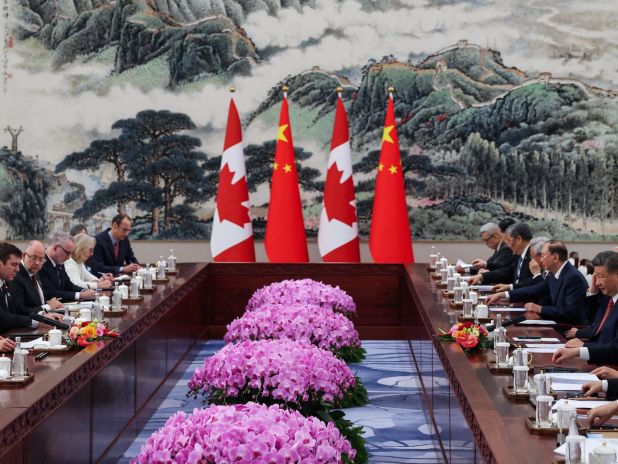
President Xi Jinping underscored the importance of improving and developing China-Canada relations, stating that such an improvement serves both nations' interests and contributes to global peace, stability, development, and prosperity. At the APEC summit, in a meeting with Canadian Prime Minister Mark Carney in Shenzhen, Xi noted that mutual respect, equality, and mutual benefit, along with an effort to find common ground despite differences, are key drivers of their bilateral relationship. Xi proposed four areas for advancing Sino-Canadian ties: fostering a better understanding of each other's development paths, deepening cooperation in trade, energy, agriculture, and finance, strengthening people-to-people cultural exchanges, and upholding the multilateral trading system. Xi's comments followed recent tariff reductions on Canadian pork and seafood, and a commitment by Canada to increase exports to China by 50% by the end of this decade, suggesting a more stable and predictable bilateral relationship.
Carney and Xi also agreed to extend and expand a pre-existing arrangement to improve Chinese market access for Canadian farmers and seafood producers, with China providing tariff relief for about C$400 million in Canadian exports, including frozen pork and fish and seafood. Canada, in turn, agreed to extend tariff relief for specific Chinese steel and aluminum products. This meeting marks the third between Carney and Xi since Carney became prime minister, highlighting the ongoing efforts to enhance economic cooperation. Additionally, Chinese automakers, such as BYD, Geely, and Chery, have entered the Canadian market following a tariff reduction on annual imports of Chinese cars, and China has also reduced tariffs on Canadian canola seed and extended tariff relief for other products like lobster, crab, and peas.
Shipments of Canadian crude oil to China have seen a rise of about 37% in 2026, according to data from LSEG. These developments reflect a broadening of economic ties and a shift towards a more nuanced understanding of each other's economic interests, positioning China and Canada for a more robust and diversified bilateral relationship.