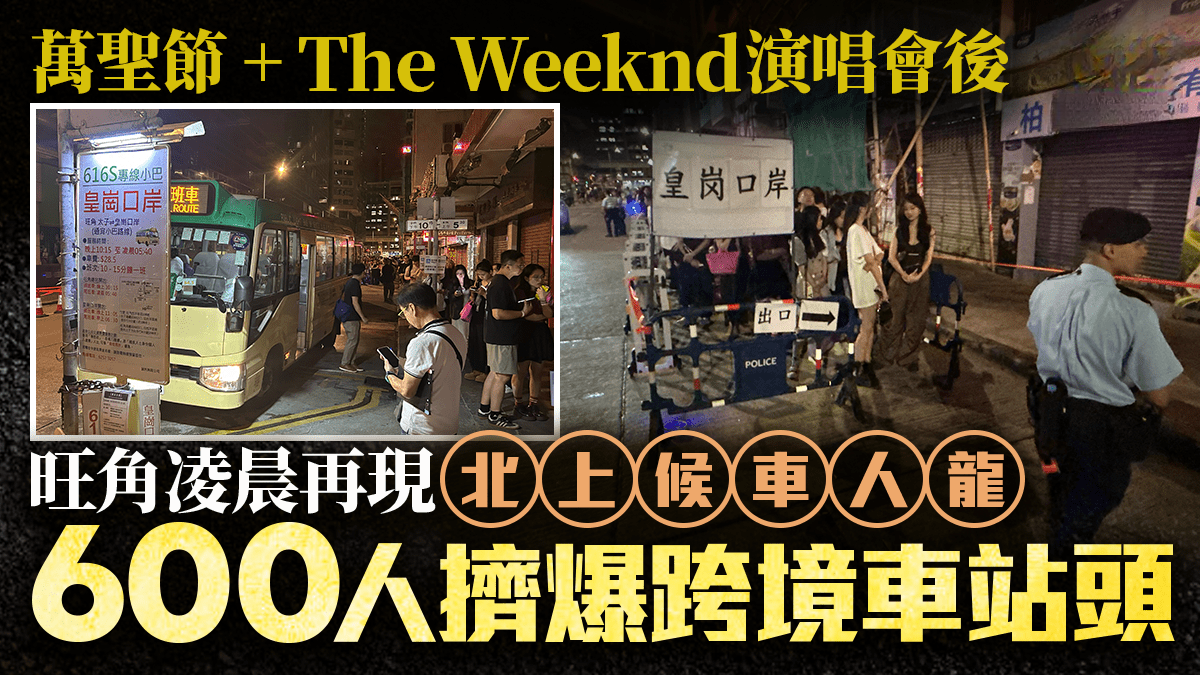
Hong Kong's Mong Kok witnessed a large number of mainland-bound travelers after Halloween. Early today (November 1), the vicinity of Street Yip Po Sai Nam, leading to Lo Wu border crossing, saw a long queue at the 616S overnight mini-bus stop, with an estimated 300 to 400 people queuing. About 300 people were also waiting at the nearby Tsing Yi cross-boundary bus stop. Police officers were stationed on-site to maintain order, which was generally well-managed. At the 616S (shuttling between Mong Kok and Lo Wu border crossing) overnight mini-bus stop on Street Yip Po Sai Nam, several mini-buses were queuing up. The waiting queue extended along the pedestrian path to a considerable distance, with large numbers of passengers standing outside stores with closed doors. There, military police were on duty, using traffic cones, tape, and barriers to designate a queuing path and directional signs. At the cross-boundary bus stop in Tsing Yi, Peng Xiaojin, a mainland visitor from Guangdong, had just attended a live concert by Canadian superstar Weeknd. She stated that she waited for about half an hour to get on the bus, finding it quicker than expected. Meanwhile, New Lo Wu border crossing also saw outbound traffic in the early hours. According to the Security Bureau's website, as of 12:30 AM, visitors needed to wait for 45 minutes while Hong Kong residents only needed to wait 25 minutes.
The phenomenon of large crowds at Mong Kok's cross-boundary mini-bus stops occurs periodically during holidays and weekends. On Halloween night, the incidence of such scenes can be attributed to the typical surge in mainland-bound travelers, especially after cultural events such as concerts in Hong Kong. The well-organized on-site arrangements by the police indicate a continued focus on ensuring smooth transportation and maintaining public order. While the specific numbers may vary, the general process for travelers remains consistent, with passengers typically requiring at least 30 minutes to an hour to board their vehicles, depending on the time of day and operational schedules.