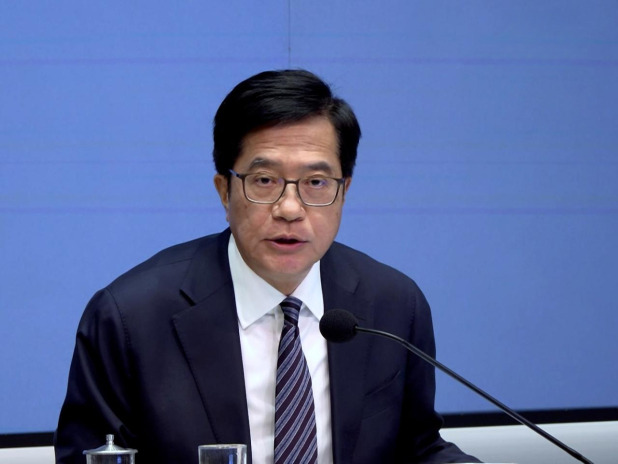
Deputy Financial Secretary Michael Wong announced that the government will set up a "one-stop liaison service" to handle homeowners' inquiries and complaints related to future building renovation projects. This comes as part of a set of comprehensive reforms aimed at preventing a recurrence of the Wang Fuk Court fire incident that claimed 168 lives last year. A report highlighting the shortcomings of contractors and government departments regarding the tragedy was released alongside the reforms. The Housing Bureau's Independent Checking Unit (ICU) will be disbanded and replaced by a Public Housing Building Control Section within this month. Project-specific teams will be established to assist housing estates with large-scale maintenance and renovation works, with a liaison officer serving as the main point of contact for the owners' corporation and residents. Wong stated that the new liaison officer system would provide direct and swift communication for homeowners, making it more efficient than current internal referrals. In addition to human intervention, the government plans to leverage artificial intelligence to speed up processes such as document auditing and analysis. Wong explained that while AI can efficiently detect anomalies, the final judgment will still require human involvement. Any issues flagged by AI will be manually followed up by authorities.
The move towards a more streamlined service for homeowners is part of the government's broader efforts to address concerns and improve the building maintenance industry. The decommissioning of the ICU and establishment of a Public Housing Building Control Section reflect the recognition of long-standing issues and the need for structural changes. The introduction of artificial intelligence also signals a shift towards greater use of technology in public administration. However, there remains a need for human oversight to ensure that critical judgments are made accurately and fairly.
The "one-stop liaison service" and the use of AI in document processing represent significant changes for residents dealing with building maintenance matters. These measures are expected to enhance residents' experience by providing clearer and faster communication channels. The reforms aim to build trust between homeowners and the authority by addressing the practical challenges faced by residents. As the government implements these changes, the effectiveness of the new system will be closely monitored to ensure that it meets the needs of the community.