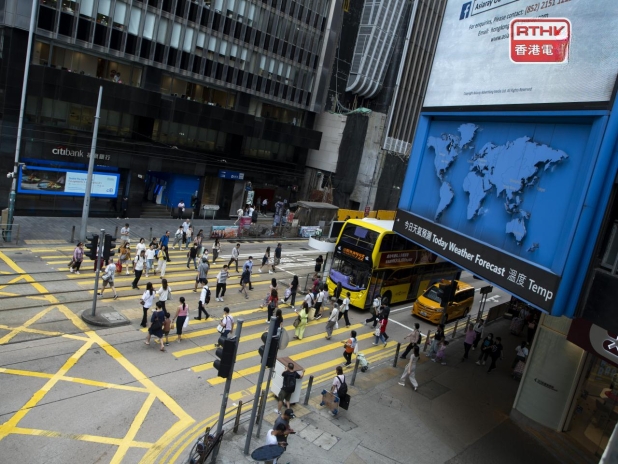
A local economist has noted that while Hong Kong's third-quarter GDP growth of 5.2 percent year on year signals a recovery in the business sector, particularly in prime office space, the overall recovery remains uneven and will likely take time to become more widespread. According to Ho Lok-sang, the office take-up rate for Grade A central locations is impressive, indicating a robust recovery in that segment. However, he stresses that demand remains weak in areas outside these prime locations and for commercial properties. Further recovery will depend on lower rents. Ho is more optimistic about the outlook for the rest of the year, expecting growth to exceed four percent, possibly reaching as high as 4.5 percent. This optimism rests on the strong performance of the financial sector, with continued high levels of initial public offerings, and the positive state of exports, although construction demand, retail consumption, and restaurant businesses remain weak. To support these sectors, Ho highlights the importance of enhancing major events and tourism. Kenny Shui from Our Hong Kong Foundation sees a broader growth momentum with increased goods and service exports, but also highlights that private consumption growth remains slow, at just 2.8 percent. He expects fourth-quarter growth to be around four to five percent and full-year growth to be around five percent, indicating an upward revision from the government’s forecast of 3.5 to 4.5 percent. Shui warns that rising interest rates could dampen business investment and household spending, and with unemployment at 3.9 percent, consumption still requires job and income support. He concludes that the fourth quarter will crucially depend on the strength of exports, improvement in consumption, and job creation.
A key indicator of Hong Kong's economic recovery, the third-quarter GDP growth of 5.2 percent, has met with mixed reviews from economists. While professor Ho Lok-sang acknowledges the impressive office space absorption in central areas, he cautions that this strength has not spread to other commercial segments. Ho predicts a prolonged period of recovery, emphasizing the need for lower rents to facilitate a broader economic revival. This insight is reinforced by Shui from Our Hong Kong Foundation, who notes that while growth is broadening, the positive momentum has not yet permeated households and retail sectors fully. Notwithstanding these challenges, both Ho and Shui remain cautiously optimistic about the full-year growth prospects, with Shui predicting a full-year growth rate of approximately five percent, potentially above the government's forecast. However, they both highlight the risks posed by rising interest rates and unemployment, highlighting the necessity for job and income support to sustain this growth trajectory.
Ho Lok-sang, an adjunct professor at the Education University of Hong Kong, points out that despite the third-quarter economic growth of 5.2 percent, the recovery in Hong Kong is uneven. The recovery is strongest in prime office spaces, especially in central Grade A locations, but there is still weak demand in surrounding areas and for commercial properties. Ho suggests that lower rents are necessary for a broader economic recovery and that it will take time to materialize. In contrast, Shui from Our Hong Kong Foundation is more positive about the economic outlook, projecting full-year growth to be around five percent, possibly even reaching 4.5 percent. Shui, however, warns about the risks posed by rising interest rates and low private consumption, suggesting that support is needed in the form of job and income growth. The key to sustaining this growth in the fourth quarter, according to Shui, will be the stability of exports and improvements in consumption and employment.