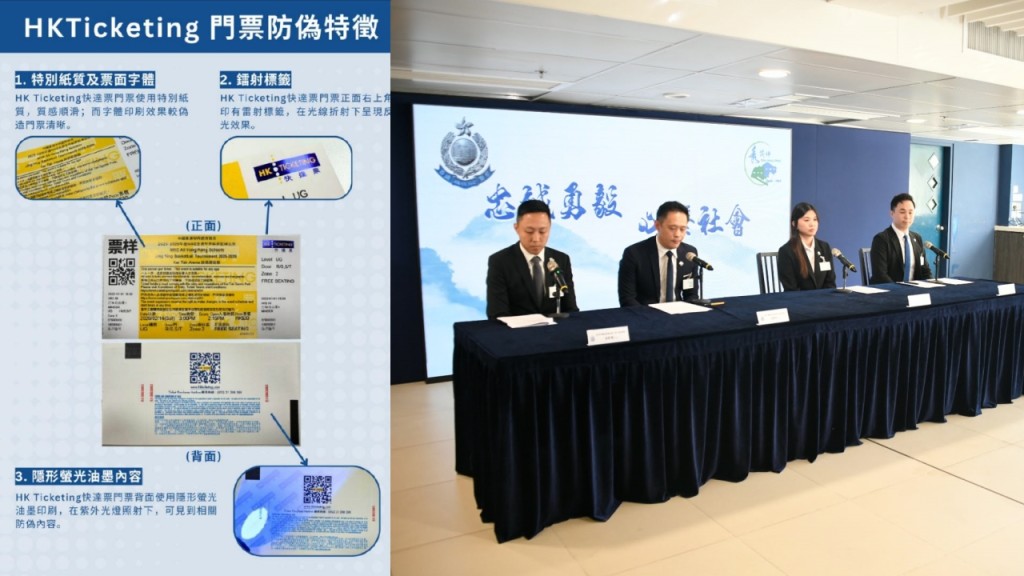

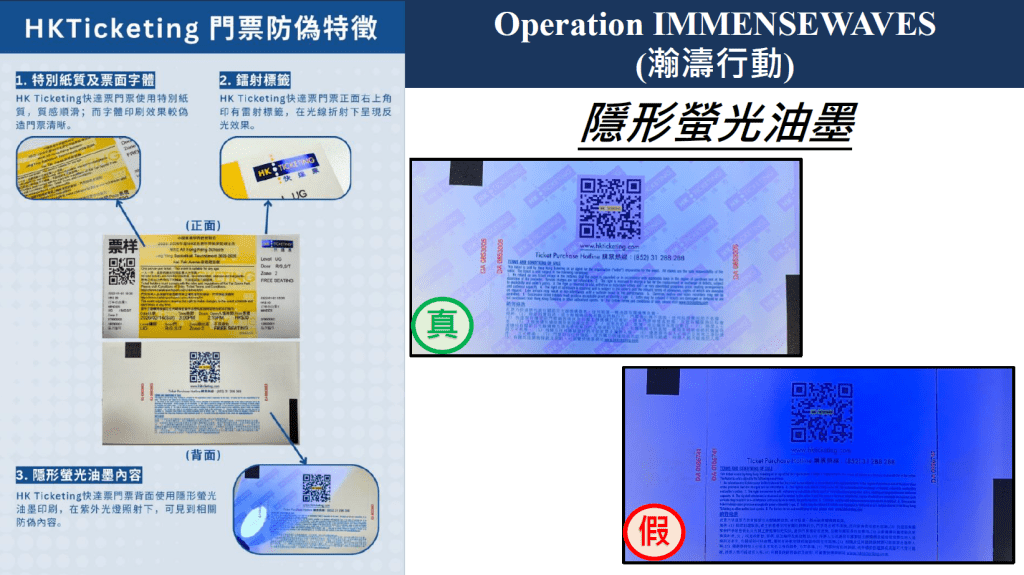
The vibrant entertainment economy in Hong Kong has led to a surge in demand for tickets to popular concerts and sporting events, unfortunately attracting scam operations seeking to profit from this high demand. On Tuesday and Wednesday of this week (November 10 and 11), the Kwun Tong Police Division launched Operation Hantao, a comprehensive law enforcement operation aimed at cracking down on online ticket scams and selling fake tickets. The operation resulted in the arrest of 10 individuals, including 8 alleged masterminds and key figures of a local fake ticket scam group. Police noted that while the fake tickets were highly realistic, there were still three flaws that buyers should be aware of to avoid falling victim to such scams. Assistant Superintendent Wong King Hang of the Kwun Tong Police Division stated that Hong Kong has initiated an active push toward the entertainment economy with popular concerts and sporting events in high demand. Fraudsters targeted this situation by posing as sellers on online platforms, claiming they had tickets for sale at reduced prices to deceive buyers into parting with their money. One of the groups fabricated fake tickets for sale, while others set up fake social media pages impersonating physical stores or Japanese and Korean convenience stores, even using addresses associated with innocent merchants to display seemingly large inventories of tickets to attract buyers. Detective Superintendent Tse Wn Ling of the Kwun Tong Police Division said that the fake ticket scam group had a clear structure. The masterminds would post ticket-selling posts on social media two days before major events, using phrases like "half-price promotions, no advance booking, can meet in person" to draw in unsuspecting buyers. Once a buyer agreed to the transaction, a scammer with a replica ticket would arrange to meet the buyer at a metro station on the day of the event. To increase credibility, the scammer would pretend to show ticket verification skills, misleading the buyer into a hasty purchase. The scammer would then demand immediate cash payment or transfer money to a specified 'mule' account before disappearing, with the online post being immediately deleted. Once the buyer attempted to enter the venue or the ticket was checked, it became clear that the ticket was fake, with no recourse to recovery. Assistant Superintendent Wong King Hang and Detective Superintendent Tse Wn Ling, alongside Detective Superintendent Yao Gangquan and Detective Superintendent Zhu Jianle, conducted an inspection during Operation Hantao. The police used detailed surveillance and analyzed phone records and money trajectories through schemes like the Sharp Eye program to identify key members of the fake ticket scam group. They carried out the operation on Tuesday and Wednesday, arresting eight key figures (five men and three women aged 18 to 46) of the group, several of whom reportedly had triad backgrounds. The police believe this fake ticket scam group was still nascent and had been successfully dismantled, targeting unwitting individuals looking for quick gains to provide personal accounts for receiving scam proceeds. Assistant Superintendent Wong King Hang also mentioned that despite the high realism of the fake tickets, there were still three flaws buyers could identify. These included the absence of anti-counterfeiting stamps, rough paper quality, and dimmer color tones. True tickets had smooth paper and clear printed text; in the upper right corner, there was a laser tag that would reflect light when viewed from different angles; and under a UV lamp, the back revealed invisible fluorescent ink content. If buyers had doubts about their tickets, they should contact the event organizers or report to the police immediately.
Detective Superintendent Tse Wn Ling demonstrated three tips for identifying genuine tickets, explaining that while fake tickets could be highly realistic, three flaws could still be detected by buyers. First, fake tickets lacked anti-counterfeiting watermarks; second, the paper quality was rough, and the print colors were dull. True tickets had smooth paper and clear print; the upper right corner had a laser tag that would reflect light when viewed from a specific angle; and under a UV light, the back showed invisible fluorescent ink text. If buyers suspected the authenticity of their tickets, they should contact the event organizers or report to the police.