
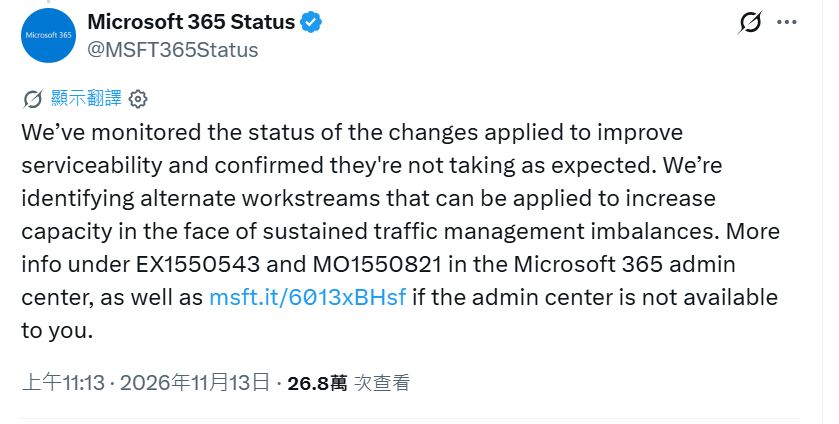
Microsoft's cloud office service, Microsoft 365, experienced a global outage on the morning of March 13, affecting Copilot AI function, the email service Exchange Online (Outlook), and the communication software Teams. Microsoft activated emergency server restarts to gradually restore services, but by early morning, tens of thousands of reports of issues were still being received. Users, including those in Hong Kong, may have faced disruptions in email communication and online meetings. At around 11:00 AM Hong Kong time, Microsoft announced on its social media platform X that their attempted repair measures did not meet expectations, and they were testing new repair solutions. The outage began around 1:00 PM Eastern Standard Time on March 12 (3:00 AM on March 13 in Hong Kong), with users globally reporting issues with logging into Outlook, Microsoft Teams, SharePoint Online, and the AI assistant Copilot. According to DownDetector, the number of Outboxes with faults surged, reaching over 130,000 individual reports at its peak. Microsoft confirmed a global service disruption, affecting users in all regions. The company identified the cause as a large number of servers unexpectedly going offline and failing automated health checks, which overloaded the remaining infrastructure and led to a cascade of problems. In response to whether the outage involved a cyber-attack, Microsoft stated there was currently no evidence of this. By the early morning of March 13, Microsoft had validated an alternative service health check method and began restarting all affected servers. The number of fault reports on DownDetector had decreased to approximately 50,000. For Hong Kong businesses relying on Outlook and Teams, employees may experience service disruptions and may need to use alternative communication tools for the time being to maintain contact. Recommendations from the Hong Kong Information Technology Chamber President Fang Baoqiao include not frequently retrying or resetting accounts, saving important emails and documents, and following up once services are restored.
Microsoft acknowledged that the outages were primarily due to the automated health checks failing to detect the sudden offline status of servers, which then overwhelmed the remaining infrastructure. The company is also aware that this incident has highlighted potential weaknesses in its automated health monitoring system, prompting a reassessment of monitoring protocols. The immediate impact on users in Hong Kong and other regions suggests that even with partial recoveries, full functionality may take time to be fully restored. Meanwhile, Microsoft is expected to issue updates on its repair efforts and provide guidelines for users on how to manage their work during the service disruption.
User feedback from various sectors indicates varying degrees of impact. For instance, some businesses experienced significant delays in email delivery, while others faced issues with scheduling meetings through Teams. There was also a notable concern about data integrity and security. Given that Microsoft's services underpin many corporate workflows, companies are now focusing on contingency plans and understanding the root cause of the incident to prevent future occurrences. In the meantime, Microsoft is likely to undergo a thorough analysis to enhance its service resiliency and automation systems. This event could also prompt a broader conversation about the reliability and transparency of large cloud service providers.