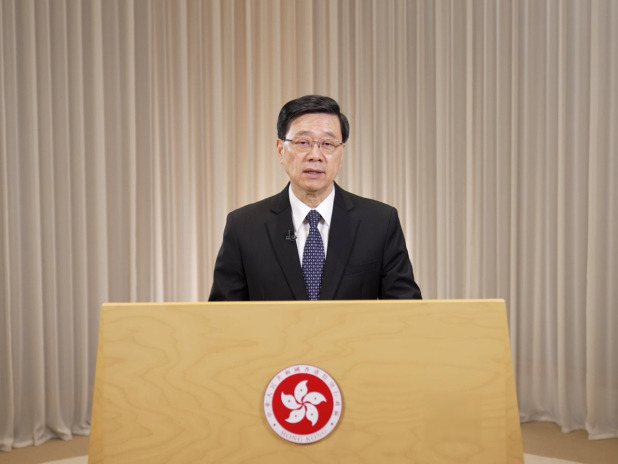
Chief Executive John Lee emphasized Hong Kong's proactive role in advancing the national initiative to develop the Guangdong-Hong Kong-Macao Greater Bay Area (GBA) into a world-class economic region. Speaking at the 16th Hong Kong International Financial Forum and the seventh Pilot "9+2" Navigation GBA Forum, he highlighted Hong Kong's strategic position under "One Country, Two Systems" as a bridge connecting the mainland and global markets. Lee underscored the importance of fostering the GBA's growth to bolster China's broader economic ambitions, including the establishment of a global association for bay areas economic cooperation, as proposed by President Xi Jinping during the Apec CEO Summit in Shenzhen.
Lee pointed out that the GBA, comprising Hong Kong, Macao, and nine cities in Guangdong, has achieved an economic output exceeding US$2.1 trillion, demonstrating resilience and vast potential. He outlined the government's commitment to deepening collaboration in four key areas: technological innovation, physical infrastructure ("hard connectivity"), regulatory frameworks ("soft connectivity"), and social integration ("heart connectivity"). By enhancing these linkages and utilizing platforms for cooperation, Hong Kong aims to facilitate the seamless movement of people, goods, capital, and information across the region. Additionally, the common law system and internationalized business environment will support enterprises through specialized services, aiding their expansion into new markets.
The Northern Metropolis university town was positioned as a critical project to integrate education, technology, industry, talent, and urban development. Lee stressed its role in becoming a hub for international talent and a platform for deeper GBA engagement, with plans to attract top mainland universities and research institutions to establish a presence there. The GBA's participation in Apec events, including last week's CEO Summit in Shenzhen and the first Apec Finance Ministers' Meeting held in Hong Kong in October, highlighted its collective contribution to Asia-Pacific cooperation and economic community-building. The initiatives aim to align with national strategies for scientific self-reliance and strengthen the region's global competitiveness. Edited by Tony Sabine